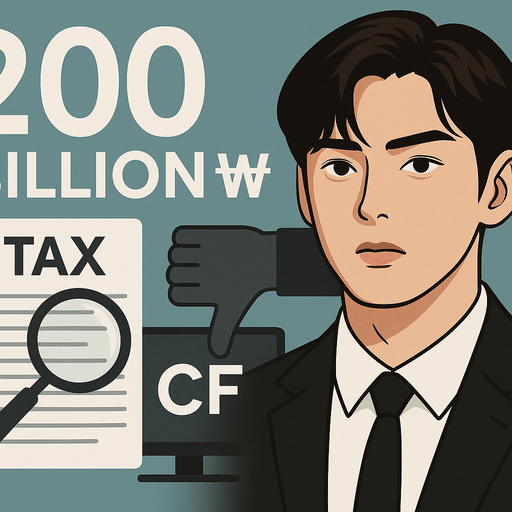

Cha Eun-woo of ASTRO has been swept up in a massive tax controversy, with Korean media reporting a reassessment of roughly 20 billion won tied to income routed through a company established by his mother. His agency Fantagio stresses that nothing has been finalized and that they will actively contest the decision through legal procedures. As the story spreads, parts of the advertising and entertainment industry are already reacting by quietly adjusting Cha Eun-woo–related content.
Cha Eun-woo Tax Controversy: What Has Been Reported So Far
According to Korean media, tax authorities notified Cha Eun-woo of an additional tax assessment of around 20 billion won, focusing on income structure involving a family company set up by his mother. The key dispute is whether this company should be treated as the proper tax subject under current law, or whether the income should instead be taxed directly to Cha Eun-woo.
The core issue, as reported, is whether the corporation established by Cha Eun-woo’s mother qualifies as the actual taxable entity under Korean tax law.
Based on currently available information, Cha Eun-woo’s side has not accepted the reassessment as final. Instead, they have initiated an administrative pre-assessment review (과세전적부심), a procedure commonly used in Korea when taxpayers dispute the legal interpretation behind a tax notice.
Fantagio’s Position: “Not Final, We Will Actively Clarify”
Fantagio has publicly emphasized that the case is still in progress. The agency has indicated that:
- The matter has not been finally determined or officially concluded.
- They will formally contest the reassessment.
- They plan to actively provide explanations through legal and administrative procedures.
Fantagio’s message can be summarized as: “This is a matter of legal interpretation, not a finalized judgment, and we will actively clarify our position.”
In general, within the K‑POP industry, it is not unusual for agencies and artists to challenge large tax assessments when the dispute centers on complex structures, such as family companies or one-person agencies. These cases often hinge on whether the tax office recognizes a company as having real substance or views it as a vehicle created mainly to reduce tax burden.
Advertisers and Industry Partners: Quiet but Immediate Reactions
The controversy has already triggered quick moves in the commercial sector. Some advertisers and corporate partners have reportedly removed, privatized, or temporarily hidden Cha Eun-woo–related advertisement videos, images, and promotional content on official channels while they monitor how the case develops.
This kind of reaction aligns with a broader trend in the Korean advertising market:
- Brands tend to minimize risk when a model faces serious legal or ethical controversy.
- SNS posts, teaser images, and video ads are often set to private rather than deleted outright, allowing companies to restore them if the situation stabilizes.
- Financial institutions and major consumer brands are particularly sensitive to public trust and may adjust campaigns quickly.
At this stage, it appears that partners are taking an interim “wait-and-see” stance rather than announcing permanent contract terminations.
Legal Focus: Family Company and Tax Subject Debate
Coverage repeatedly stresses that the heart of the dispute is legal classification, not a completed criminal judgment. In broad terms, Korean tax law looks at substance over form when deciding who should bear tax liability. In cases like this, authorities typically examine:
- Whether the family company performs actual management or support services.
- Whether business expenses and income flows reflect real economic activity.
- Whether the company was effectively used to shift income from a higher personal tax rate to a lower corporate tax rate.
Cha Eun-woo’s side is currently pursuing administrative review rather than simply paying the reassessed amount. That choice signals that they believe there is room to argue that the company should be recognized as a legitimate taxable entity under existing rules.
Impact on Cha Eun-woo’s Image and K‑POP Industry Trends
In the K‑POP ecosystem, tax issues can influence not only an idol’s public image but also their casting in dramas, variety shows, and brand campaigns. Even without a final decision, the phrase “20 billion won tax reassessment” is powerful enough to affect public sentiment and SNS reactions.
For now:
- There is no official conclusion that Cha Eun-woo committed tax evasion; the case is under review.
- The narrative in Korean media remains focused on the interpretation of tax law and the status of the family company.
- Industry insiders and fans are closely watching how the administrative process unfolds and how quickly Fantagio can present its detailed explanation.
If the review ultimately accepts Cha Eun-woo’s arguments, advertisers may gradually restore content and resume normal promotion. If not, further legal procedures and longer-term reputation management will likely follow, as is common in high-profile K‑POP and drama cases.
Key Takeaways
- Cha Eun-woo has reportedly been notified of a tax reassessment of roughly 20 billion won linked to income routed through a company established by his mother.
- Fantagio insists the matter is not finalized, stating it will formally contest the decision and actively explain its position through legal procedures.
- The core dispute is whether the family company should be treated as the proper tax subject under current law.
- Cha Eun-woo’s side has requested an administrative pre-assessment review (과세전적부심) instead of accepting the tax notice as final.
- Some advertisers and corporate partners have removed or privatized content featuring Cha Eun-woo while they monitor the outcome.
FAQ
Q1. Has Cha Eun-woo been officially found guilty of tax evasion?
Based on currently available information, no final decision has been announced. Media report that tax authorities issued a large reassessment, but Fantagio maintains that nothing has been conclusively determined and that they are contesting the case through legal procedures.
Q2. What exactly is being disputed in this tax case?
Reports indicate that the central issue is whether the company established by Cha Eun-woo’s mother should be recognized as the proper taxable entity. Tax authorities and Cha Eun-woo’s side appear to disagree on how the law should be applied to this structure.
Q3. Why are advertisers hiding Cha Eun-woo–related content?
In the Korean advertising and K‑POP industry, brands often react quickly to major controversies involving their models. Temporarily removing or privatizing ads is a common risk-management step while they wait for more clarity on the legal and public-opinion landscape.
Outlook: What to Watch Next
Going forward, the key variables will be the outcome of the administrative review and how convincingly Fantagio can argue that the family company should be treated as a legitimate taxable entity. For K‑POP watchers and industry professionals, this case will likely become a reference point in discussions about one-person agencies, family companies, and tax strategy in idol management. Until a final decision is reached, Cha Eun-woo’s team appears committed to a legal, procedural fight to defend their interpretation of the law and stabilize his standing in both the domestic and global K‑POP market.

Leave a Reply